

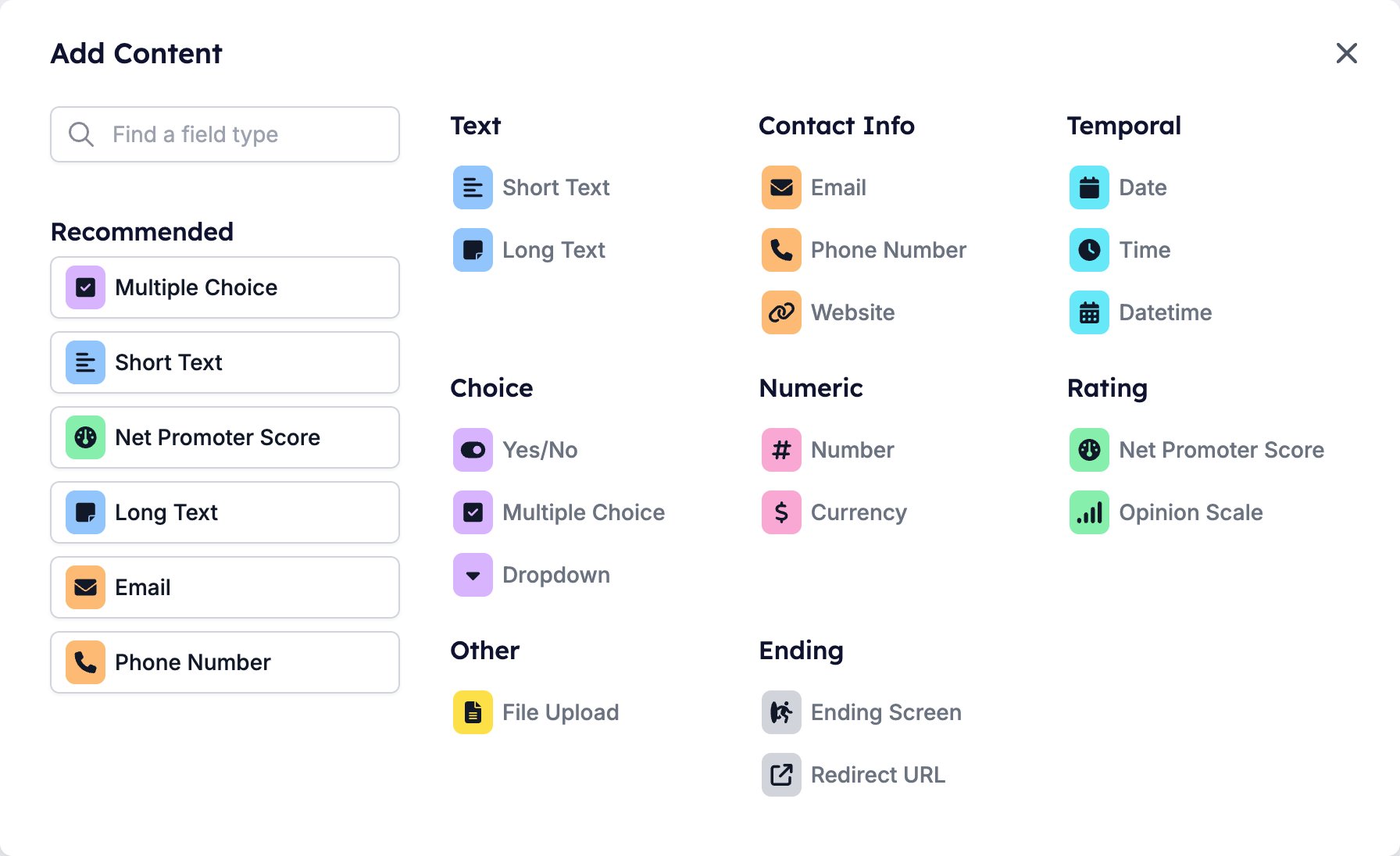
Choosing a question type
The palette shows 18 entries. Each row links to the section that describes that type.
“Works with evaluation” means the question can take part in Criteria, Scoring, and Skills on the Evaluation tab. Every question type except the two endings can. The operator groups are spelled out in Logic operators by category.
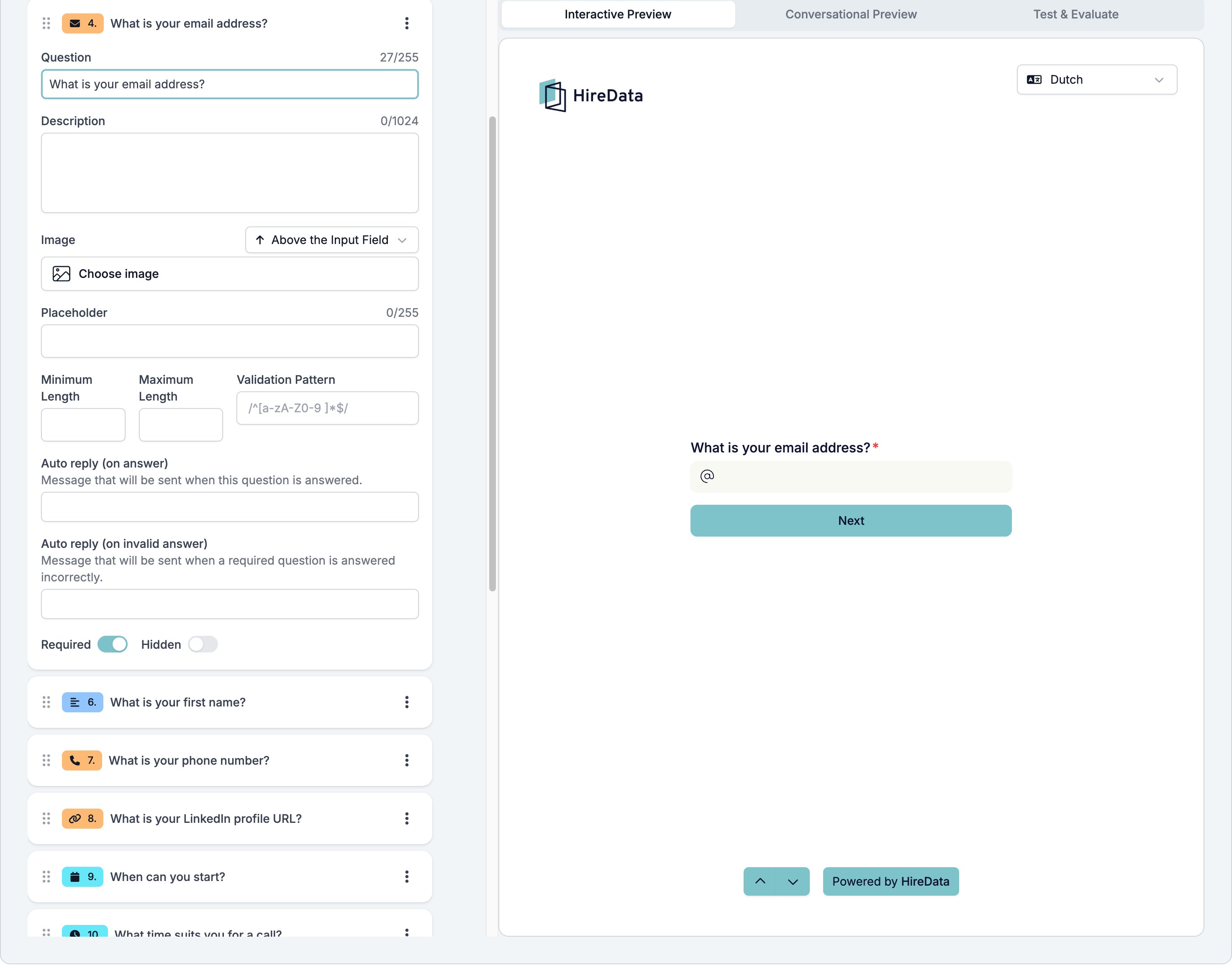
Settings every question has
Click a question in the list to open its card. The card has the settings shared by every question type at the top and bottom, with the type’s own settings in between.- Question, up to 255 characters. Ending screens call this Title.
- Description, up to 1024 characters, shown under the question.
- Image, with a placement selector that defaults to Above the Input Field. The other placements are Left Side of Field, Right Side of Field, Right Half of the Page, Left Half of the Page, and Background.
- Required and Hidden toggles in the footer.
- A type switch in the footer for types that come in two flavours: Short Text and Long Text, Yes/No’s Checkbox and Toggle, Multiple Choice and Dropdown, Net Promoter Score and Opinion Scale.
- Auto reply (on answer) is sent as soon as the respondent answers the question. Yes/No replaces it with a reply per answer, and Multiple Choice and Dropdown move it onto each option.
- Auto reply (on invalid answer) appears once Required is on. The builder describes it as the message sent when a required question is answered incorrectly.
Question types
Each section below lists the type’s own settings, what a completed form stores for it, and which operators the Logic tab offers for it.Short Text and Long Text
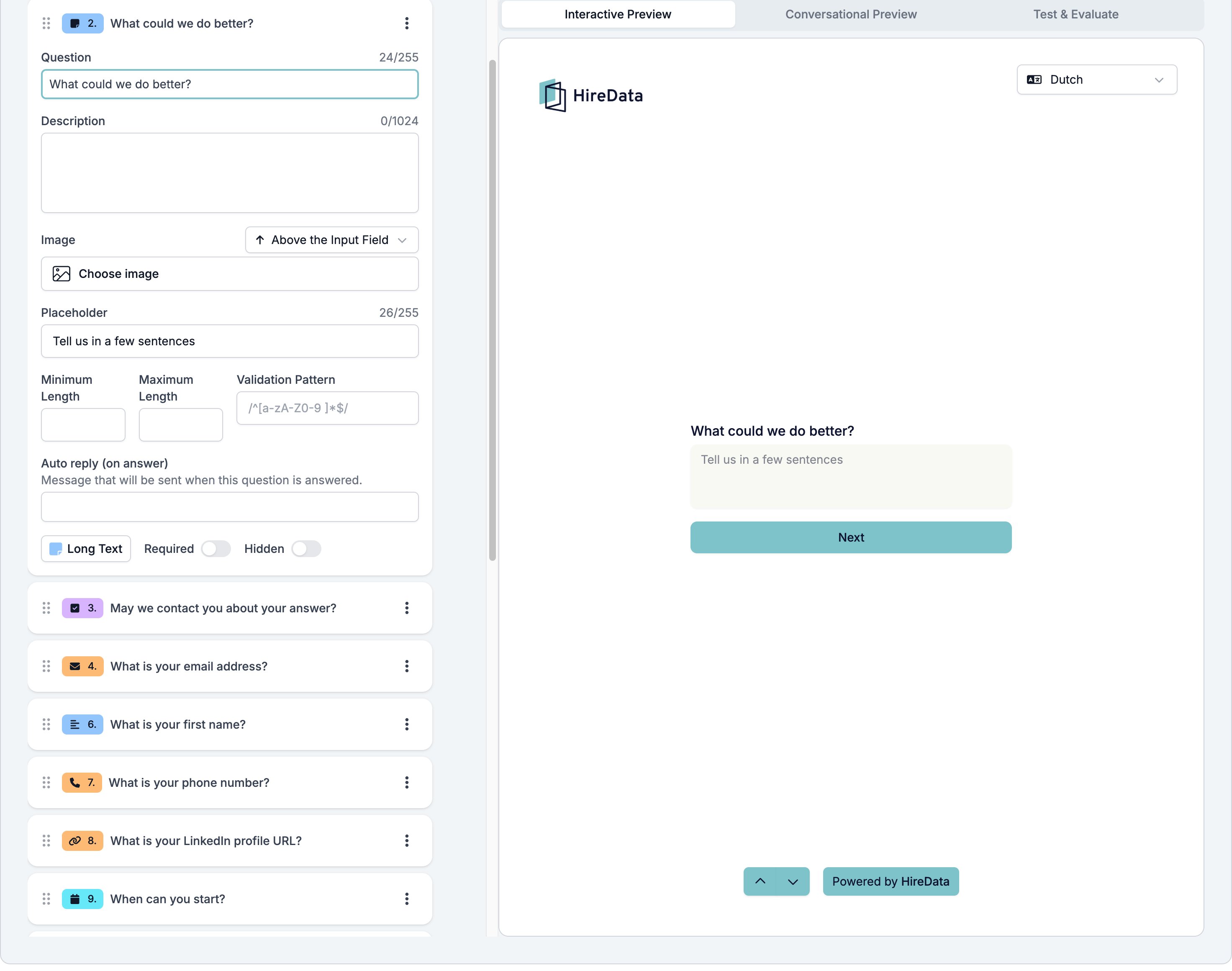
Short Text is a single line. Long Text is a multi-line box. Switch between them with the footer type switch. Settings: Placeholder (up to 255 characters), Minimum Length, Maximum Length, and Validation Pattern, a regular expression the answer has to match, for example/^[a-zA-Z0-9 ]*$/.
Stores:
The text the respondent typed.
Logic:
Has response, is equal to, is not equal to, starts with, ends with, contains, does not contain.
Criteria on a text question default to Evaluate with AI, because a free-text answer rarely matches an exact expectation.
Email, Phone Number, and Website
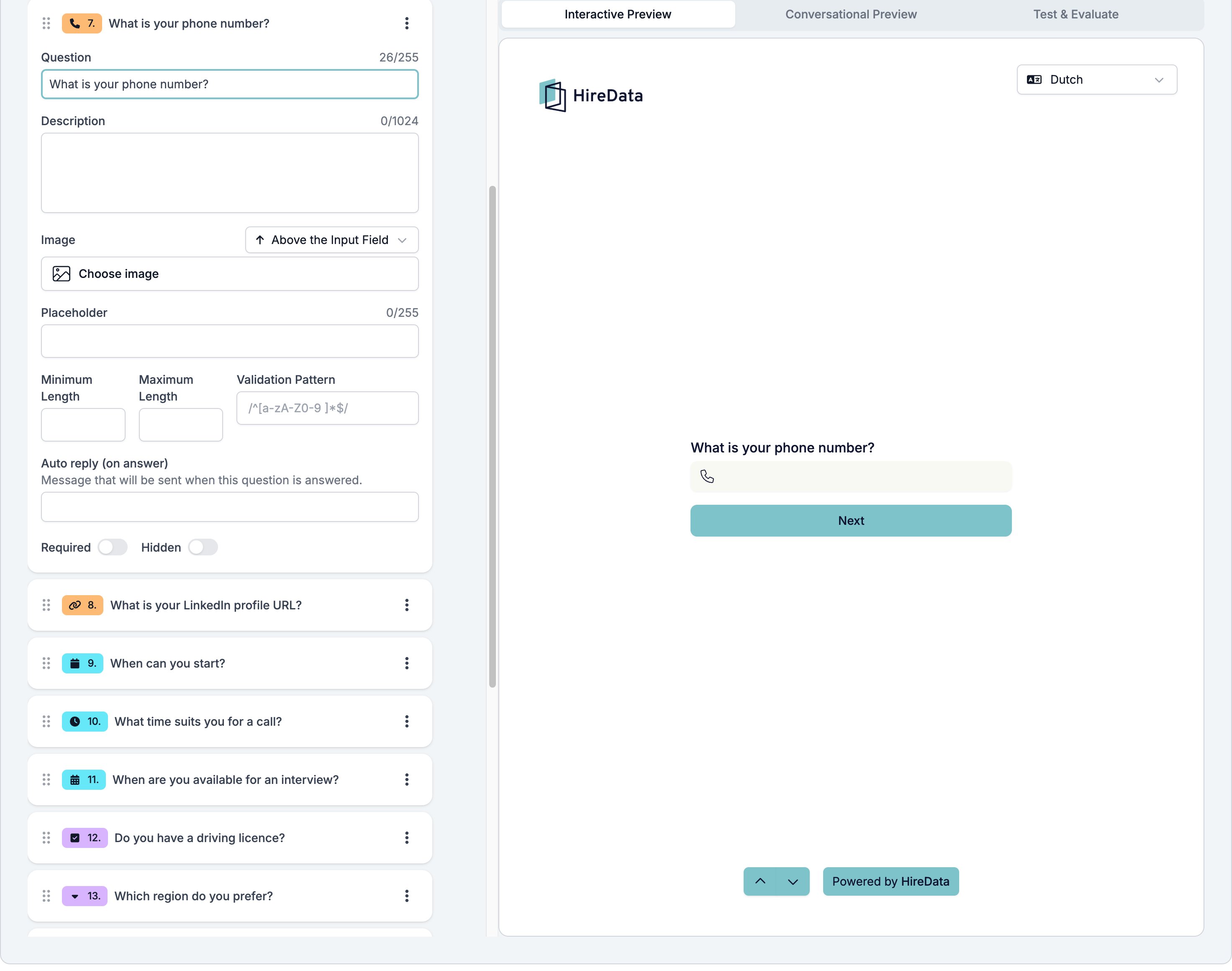
Three text questions with a format check on the answer. Email must be a valid email address. Phone Number accepts an optional leading+ and then 5 to 20 characters of digits, spaces, dots, slashes, dashes, and brackets, with at least five digits. Website must be a valid web address.
Settings:
The same as text: Placeholder, Minimum Length, Maximum Length, Validation Pattern.
Stores:
The address or number as typed.
Logic:
The text operators.
Date, Time, and Datetime
Date asks for a calendar date, Time for a time of day, Datetime for both. Settings: None beyond the shared ones. Stores: A date and time. Time answers are stored with a date attached. Logic: Has response only. The builder offers no comparisons such as “is before” for these types. Answer rules on the Evaluation tab do offer greater than and less than for dates.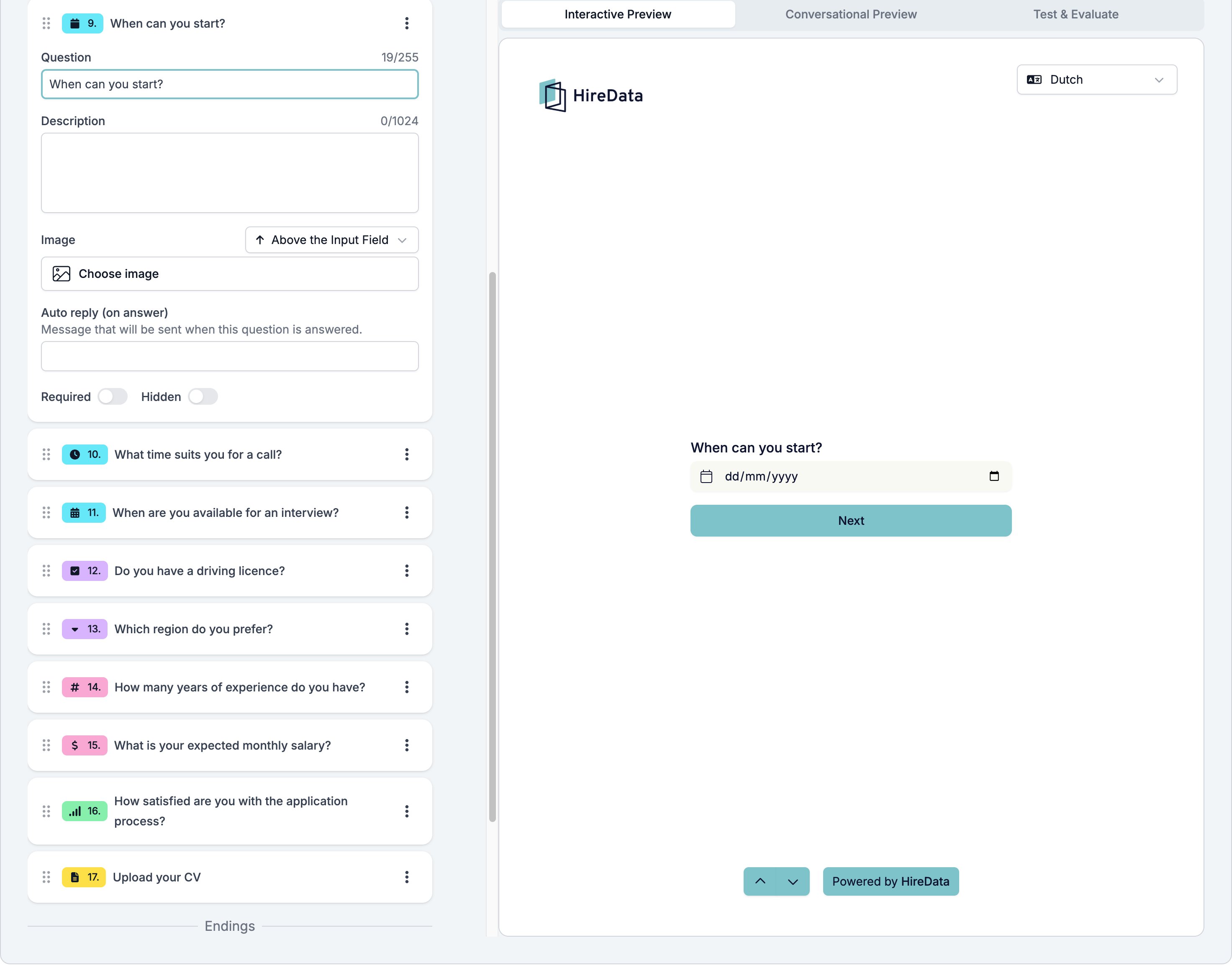
Yes/No
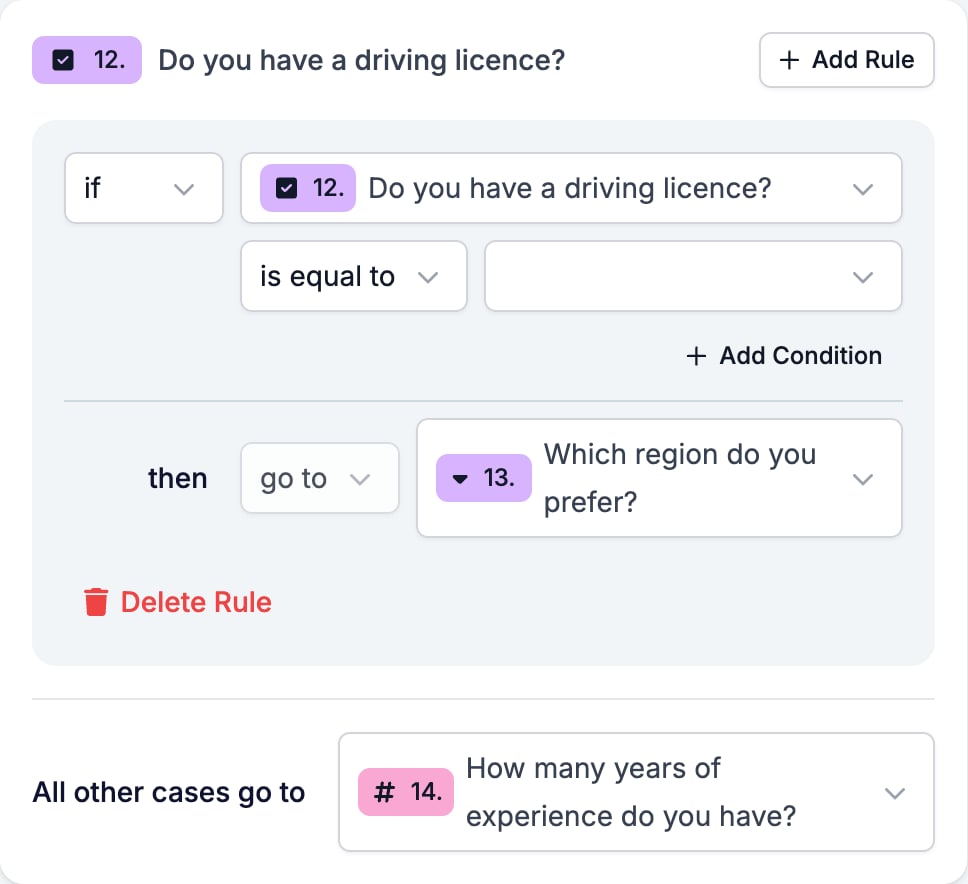
One question, two answers. New Yes/No questions start as Checkbox, a single tick box. Use the footer type switch to change to Toggle, an on/off switch. Settings: Auto reply (Yes), “Message that will be sent when the answer is Yes.” and Auto reply (No), “Message that will be sent when the answer is No.” There is no placeholder. Stores: Yes or No. A checkbox left unticked stores No. Logic: Has response, is equal to, is not equal to, with Yes and No as the values. The value box in a rule stays blank after you choose Yes or No. The choice is saved; open the picker again to see which one is selected. Read Required questions before you make a Yes/No question required. A required Yes/No question cannot be answered No in the web form today.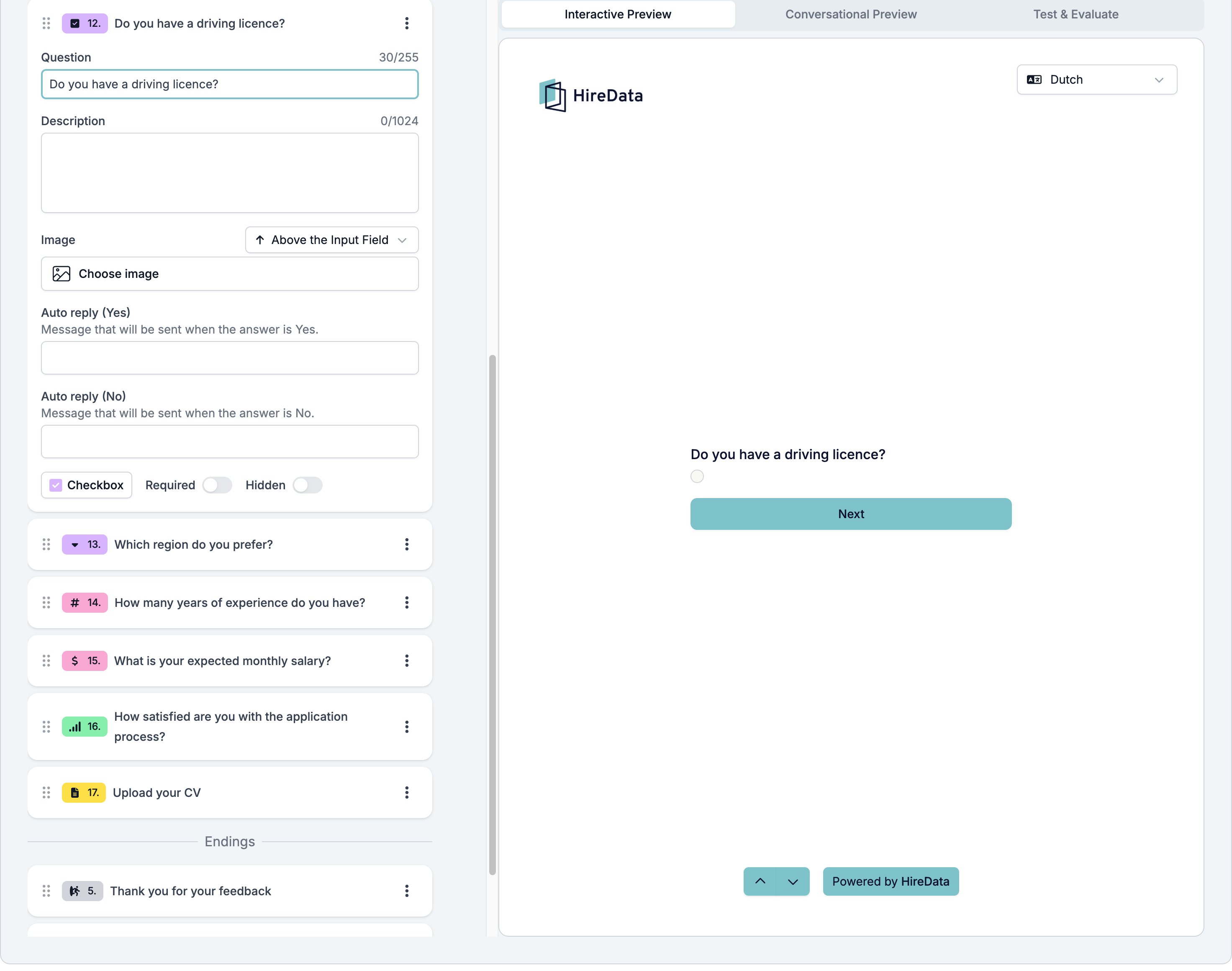
Multiple Choice and Dropdown
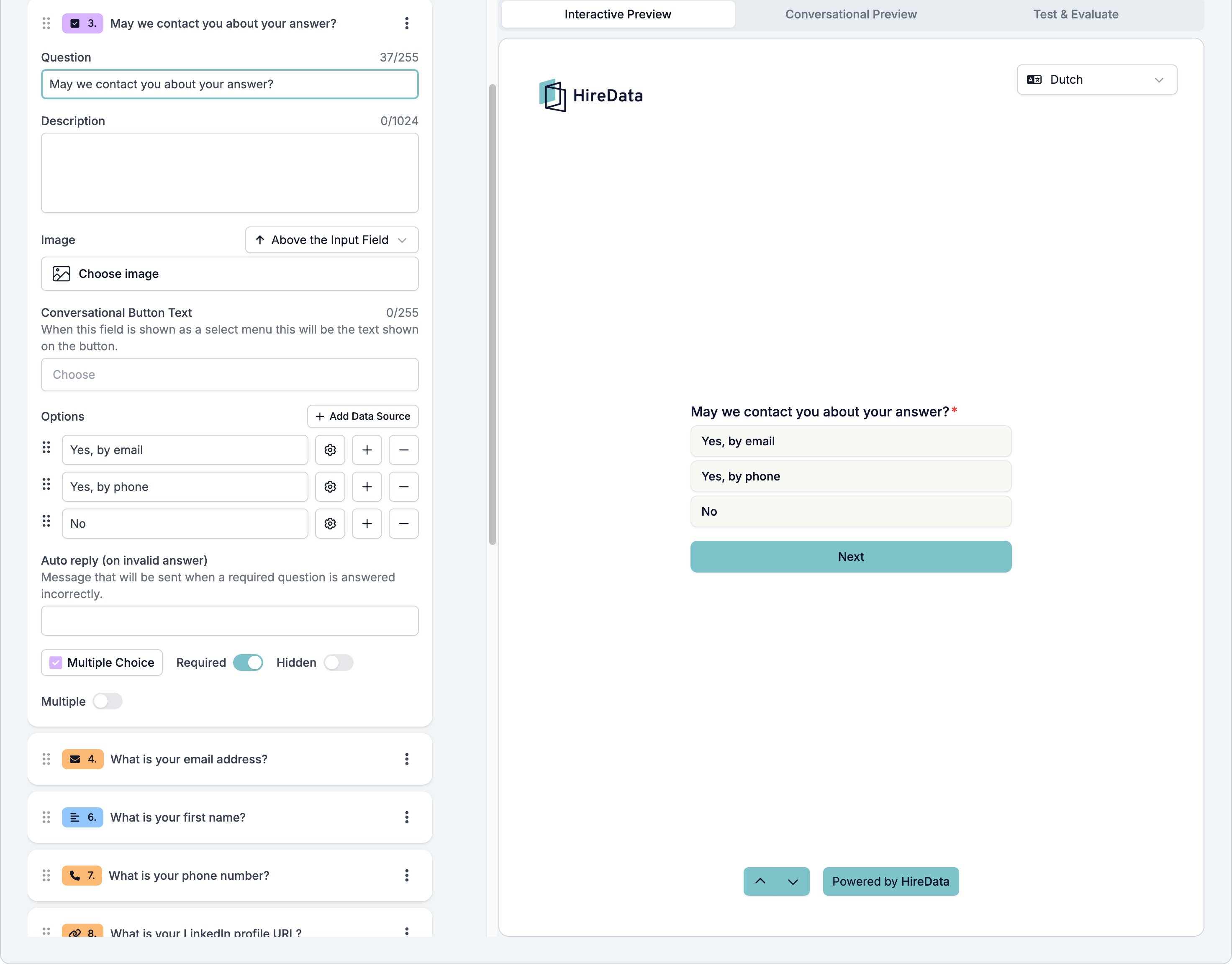
Multiple Choice shows the options as a list. Dropdown shows them in a select menu. Switch between them with the footer type switch. Settings:- Options. Each option has a label the respondent sees and a value that is stored. Drag to reorder. The cog on an option holds that option’s Auto reply (on answer).
- Add Data Source fills the options from a data source in your workspace, instead of options you type. A question uses one or the other, never both.
- Conversational Button Text, “When this field is shown as a select menu this will be the text shown on the button.” Defaults to “Choose”.
- Placeholder, Dropdown only.
- Multiple in the footer, which lets the respondent pick more than one option.
Number and Currency
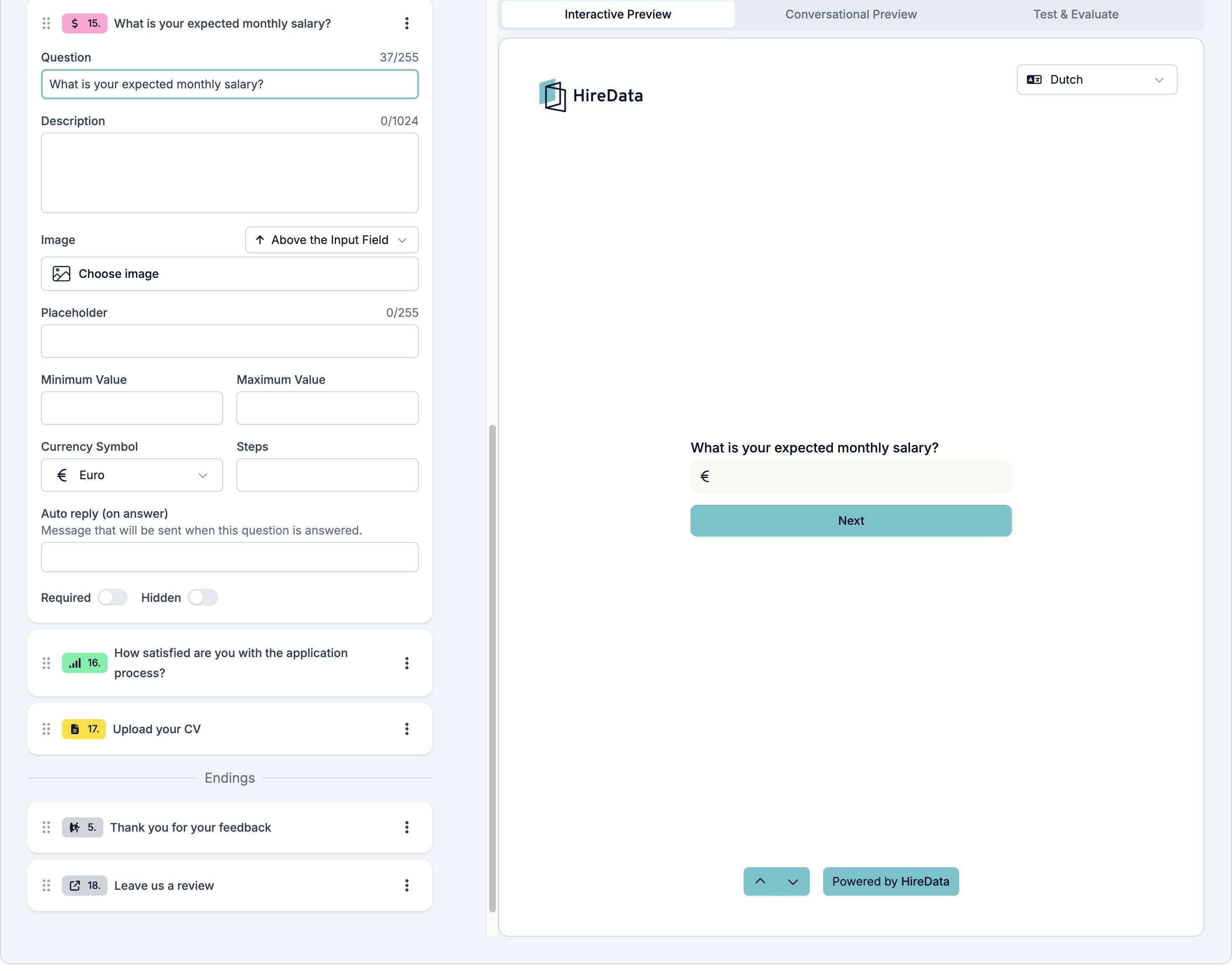
Number collects a plain number. Currency adds a symbol in front of it. Settings: Placeholder, Minimum Value, Maximum Value, Steps. Currency adds Currency Symbol with a choice of$, €, £, ¥, and ₹.
Stores:
The number. 0 is a valid answer.
Logic:
Has response, is equal to, is not equal to, is greater than, is less than, is greater than or equal to, is less than or equal to.
Net Promoter Score and Opinion Scale
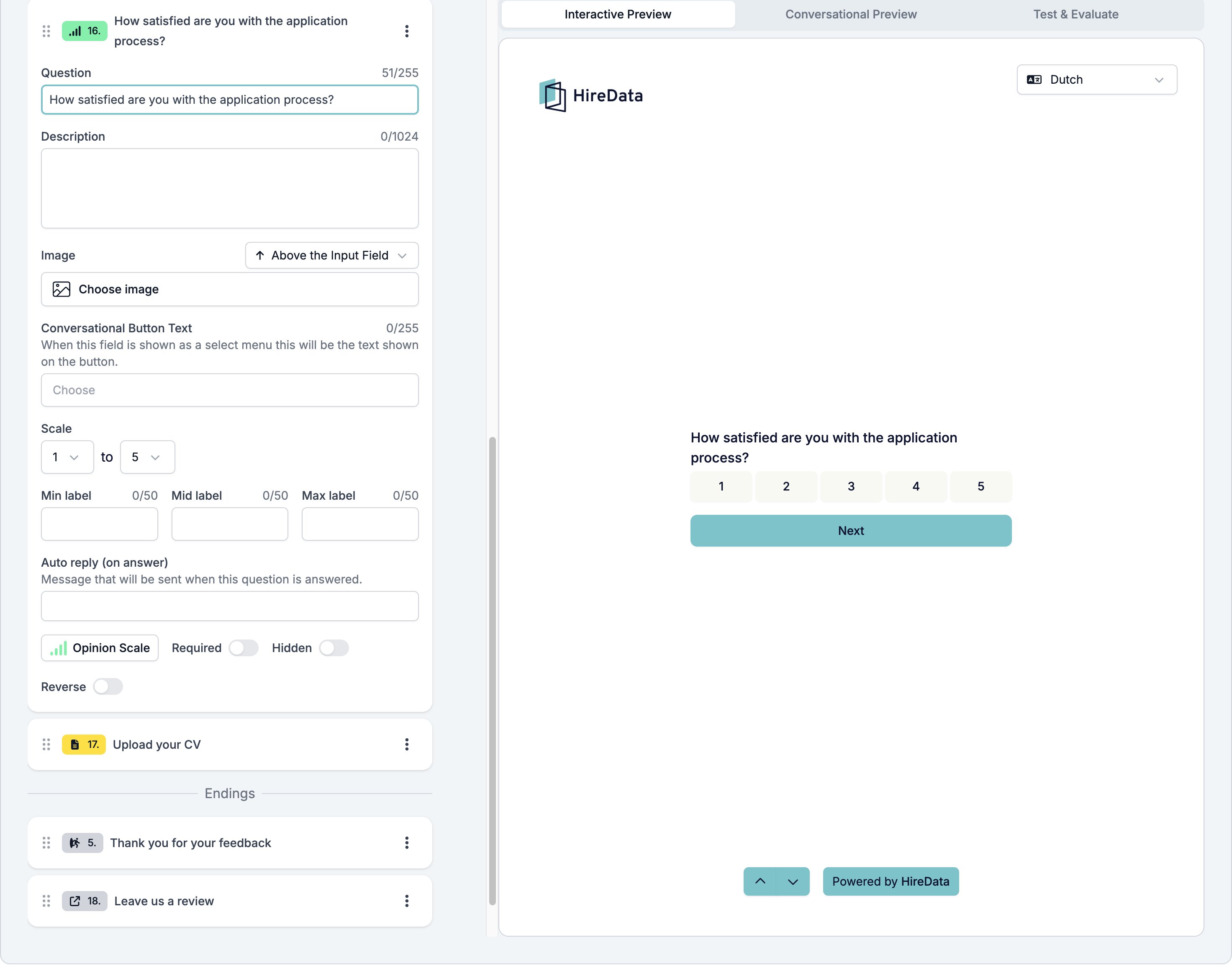
Net Promoter Score is a fixed 0 to 10 scale labelled “Not likely at all” and “Extremely likely”. Opinion Scale lets you set the scale and the labels. Switch between them with the footer type switch. Settings for Net Promoter Score: Conversational Button Text only. The scale and labels are fixed. Settings for Opinion Scale:- Scale, a minimum of 0 or 1 and a maximum from 1 to 10.
- Min label, Mid label, Max label, up to 50 characters each.
- Reverse in the footer, which shows the scale from high to low.
- Conversational Button Text.
File Upload
Lets the respondent attach files. Settings: Multiple, a Yes/No select, and File type, a preset list: Any, Image, Audio, Video, Media, PDF, Document, Powerpoint, Word Document, Sheet, Archive. Stores: The uploaded files, with their names and types. Logic: Has response only. Rule-based evaluation sees only the file names and types. AI evaluation reads the contents of JPEG, PNG, GIF, WebP, and PDF files, up to 5 files and 10 MB in total.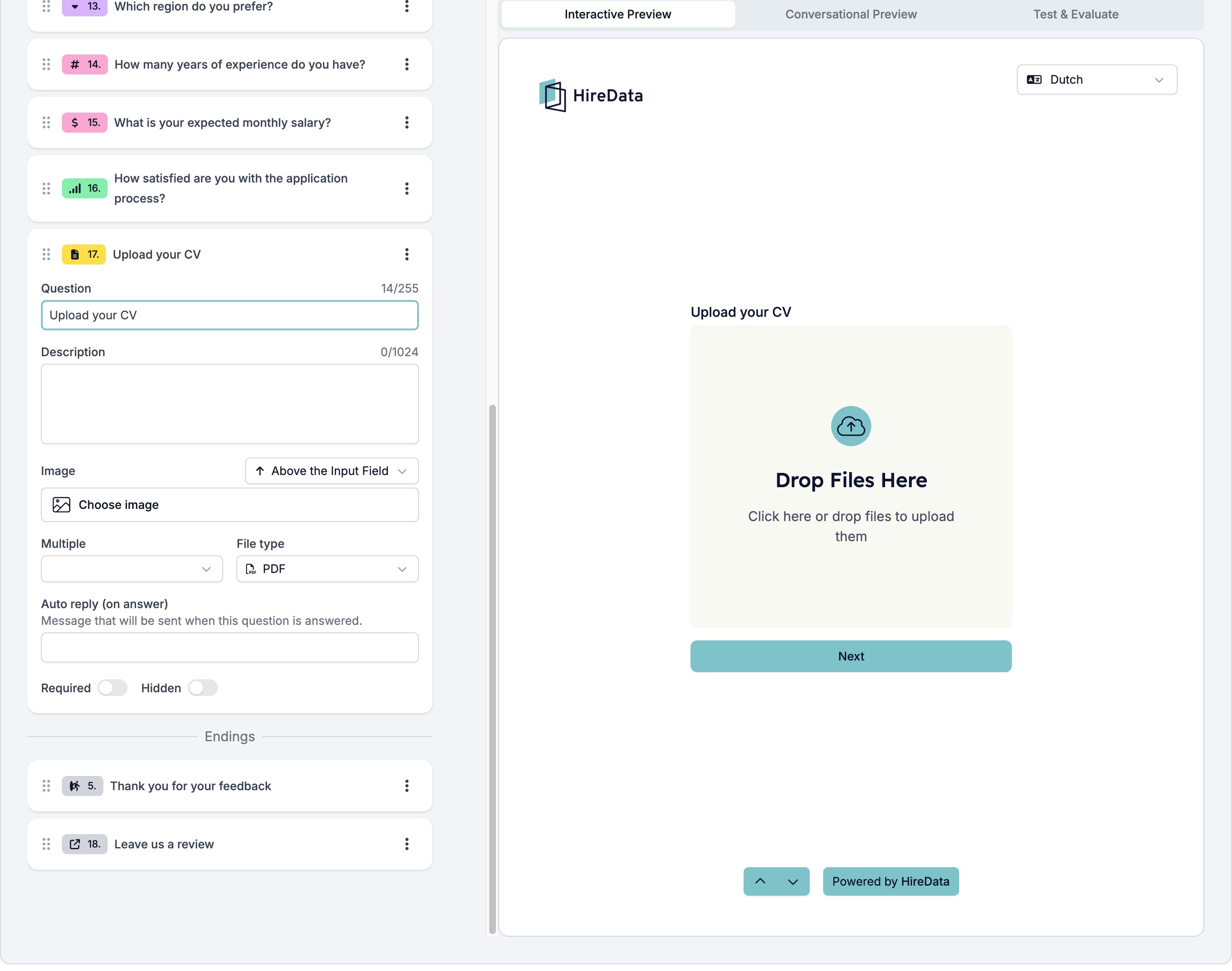
Ending Screen and Redirect URL
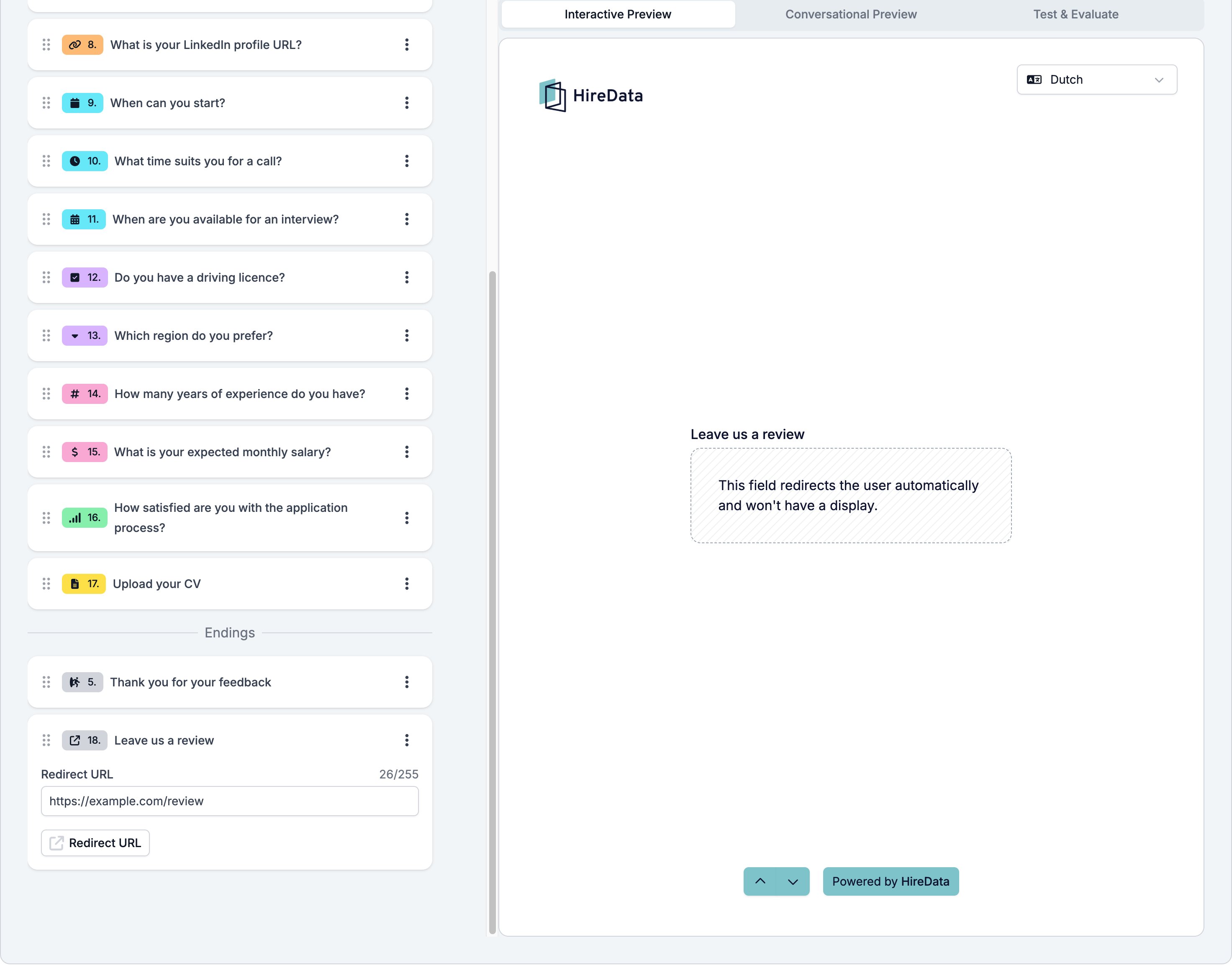
Endings sit under the Endings divider at the bottom of the question list. A form can have several, and logic rules decide which one a respondent reaches. Ending Screen settings: Title, Description, Image, and a Button toggle. Turning the button on reveals Button Text (defaults to “Submit Form”), Redirect URL, Redirect Timer, and Timer in seconds from 0 to 10. With the timer on, the form opens the redirect URL after the countdown. Redirect URL settings: A single Redirect URL field. The respondent is sent there as soon as they reach it. No title, description, image, required, or hidden. Stores: Nothing. Endings hold no answer. Logic: Endings have no Add Rule button and cannot be used in a condition. They are the usual target of a rule. Endings do not appear on the Evaluation tab.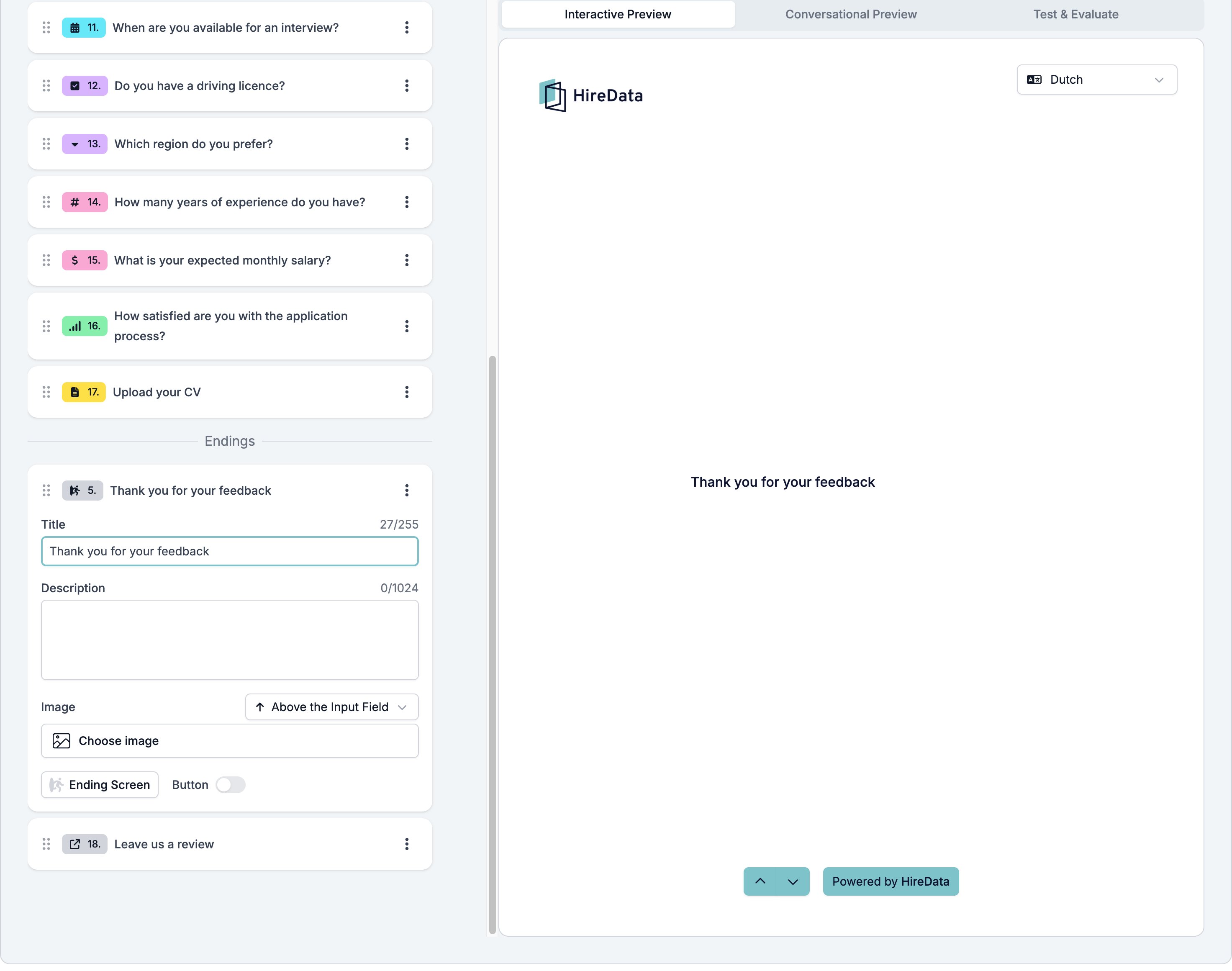
Types the builder does not show
A few more question types exist in HireData than the palette offers: Range, Color, and the Star, Thumbs, Emoji, and Slider variants of a rating. The builder cannot add them and has no settings card for them.Range, Color, and the Star, Thumbs, Emoji, and Slider ratings can only be added through an integration such as the HireData API. If one turns up in a form you did not build, it works, but you cannot change its settings in the builder.
Required questions
Turning Required on adds an asterisk to the question label and stops the respondent from continuing until the question has an answer. An empty text box, an empty number box, no option chosen, and no file attached all count as no answer. The web form then shows a message under the question, such as “This field is required and cannot be empty.” Answering No, turning a toggle off, and entering 0 are real answers and are meant to satisfy a required question. In a conversational form, Auto reply (on invalid answer) is the message sent back when a required question receives no usable answer.Objects
You can bring objects from your ATS or other apps into the form, so their fields are available as variables in your questions. To add one, click the Show objects button in the toolbar at the top right of the builder, then pick the objects you need from the menu.
Conditional logic
Open the Logic tab to attach rules to a question. Each question in the list has an Add Rule button and a footer target.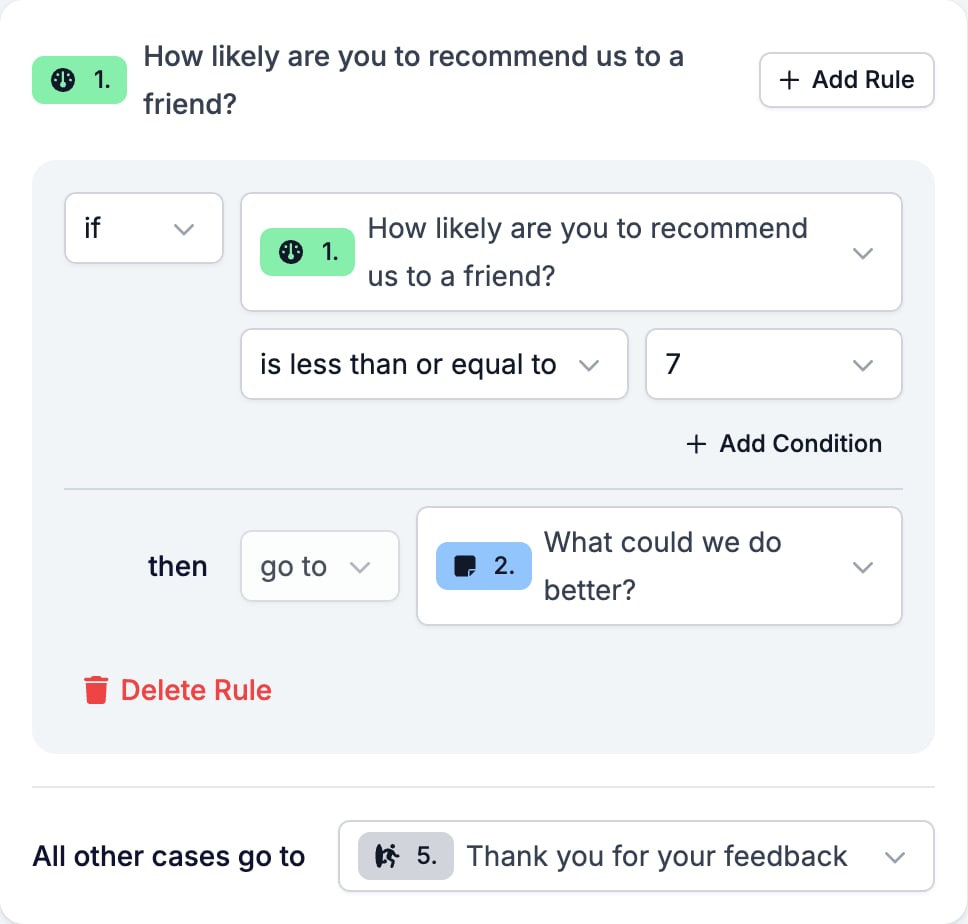
Anatomy of a rule
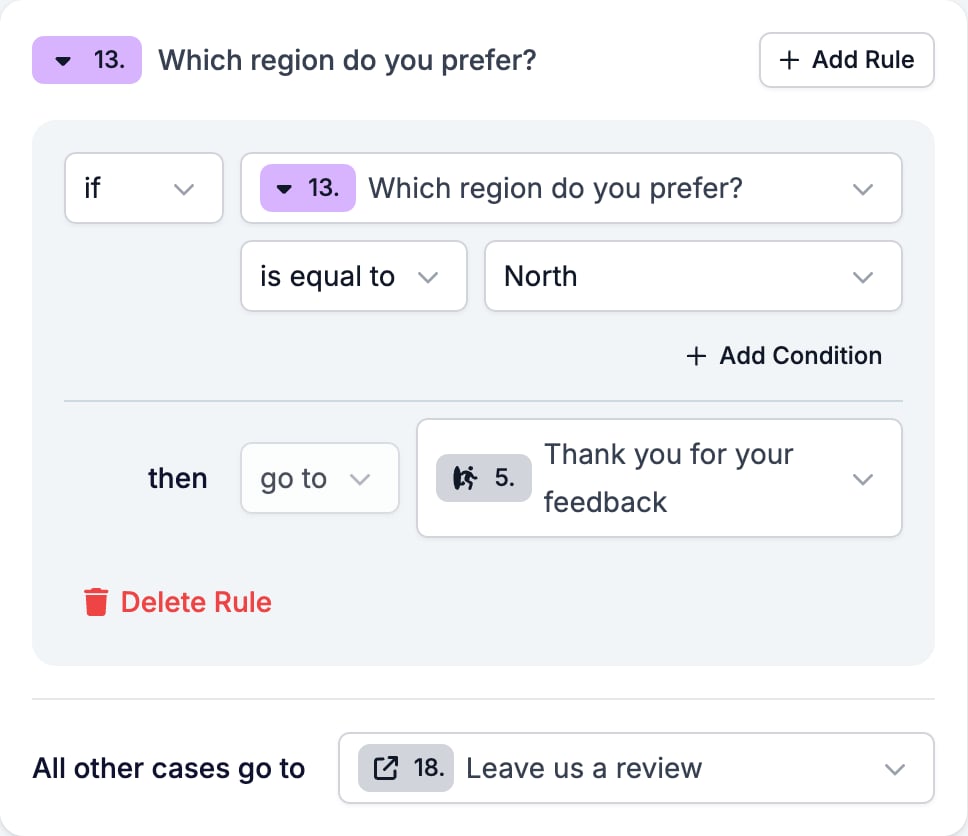
A question can carry several rules, and each rule is checked on its own. A rule readsif <question> <operator> <value> then go to <target>.
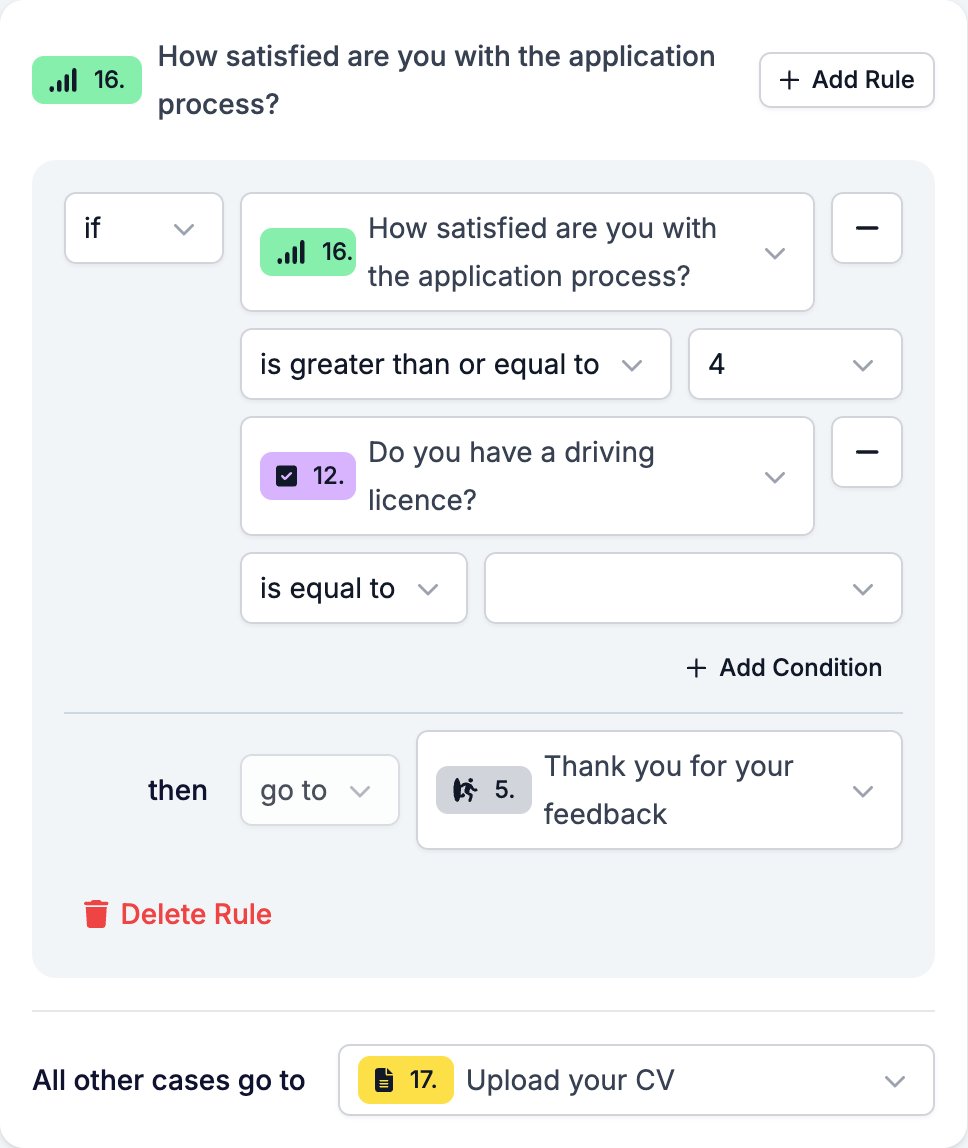
- The if row holds the rule’s conditions. Add Condition adds another one to the same rule, and a rule fires only when every one of its conditions is met. To offer alternatives, add a second rule instead.
- A condition can look at the question itself or any earlier question. Later questions and endings are not offered.
- then go to picks the target from every other question and ending. Hidden questions are excluded.
- Delete Rule removes the rule.
Logic operators by category
Every category offers has response, which is true once the question has any answer. The builder adds these per category:Logic cookbook
Each pattern below is shown as it appears on the Logic tab. Ask why after a low score. On a Net Promoter Score question, add a ruleif this question is less than or equal to 7 then go to a Long Text question such as “What could we do better?”. Set All other cases go to the ending. Respondents who score 8 or higher skip the follow-up.
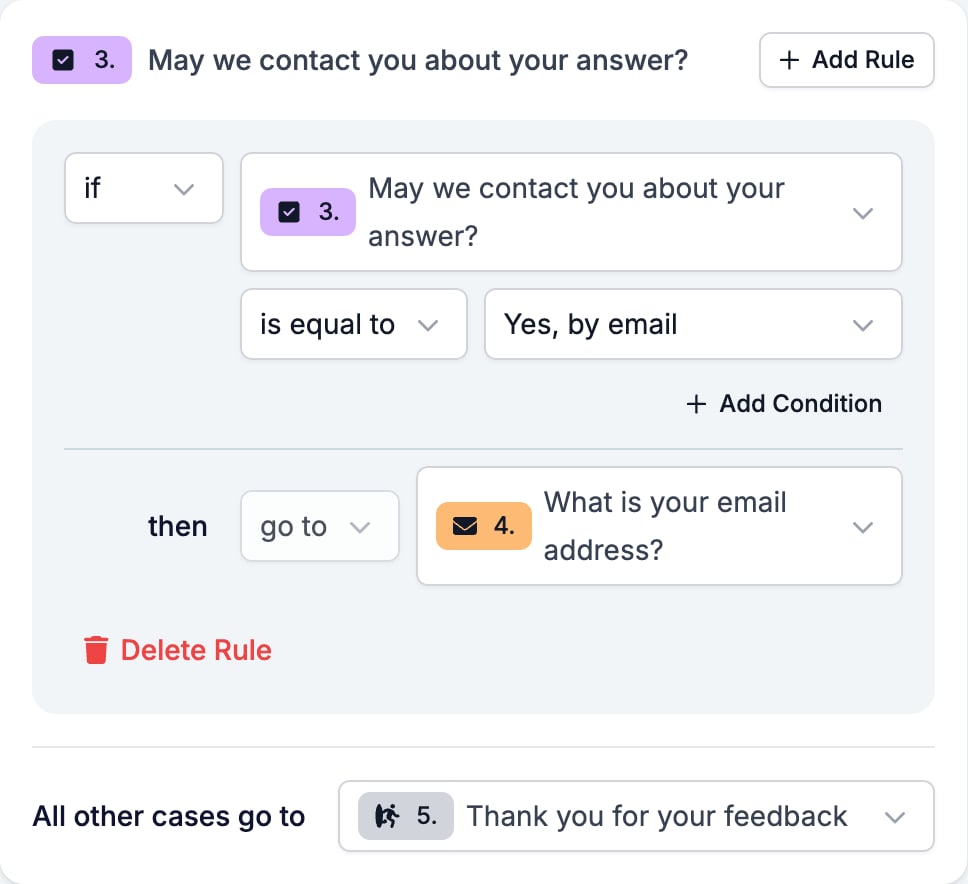
if this question is equal to “Yes, by email” then go to an Email question. Add a second rule for “Yes, by phone” that goes to a Phone Number question. Set All other cases go to the ending.
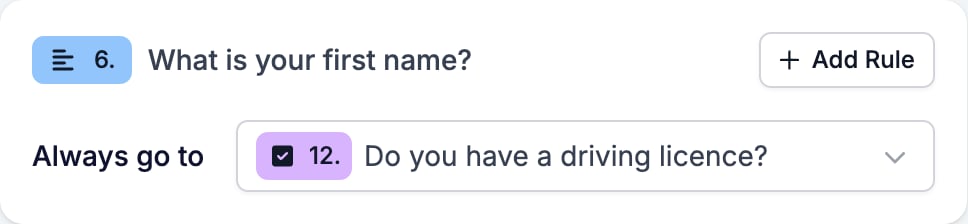
if this question is equal to Yes then go to the follow-up. Set All other cases go to the question after the follow-up. Keep the question optional until the required-field issue above is fixed. The value box shows blank even though Yes is selected; see Yes/No.
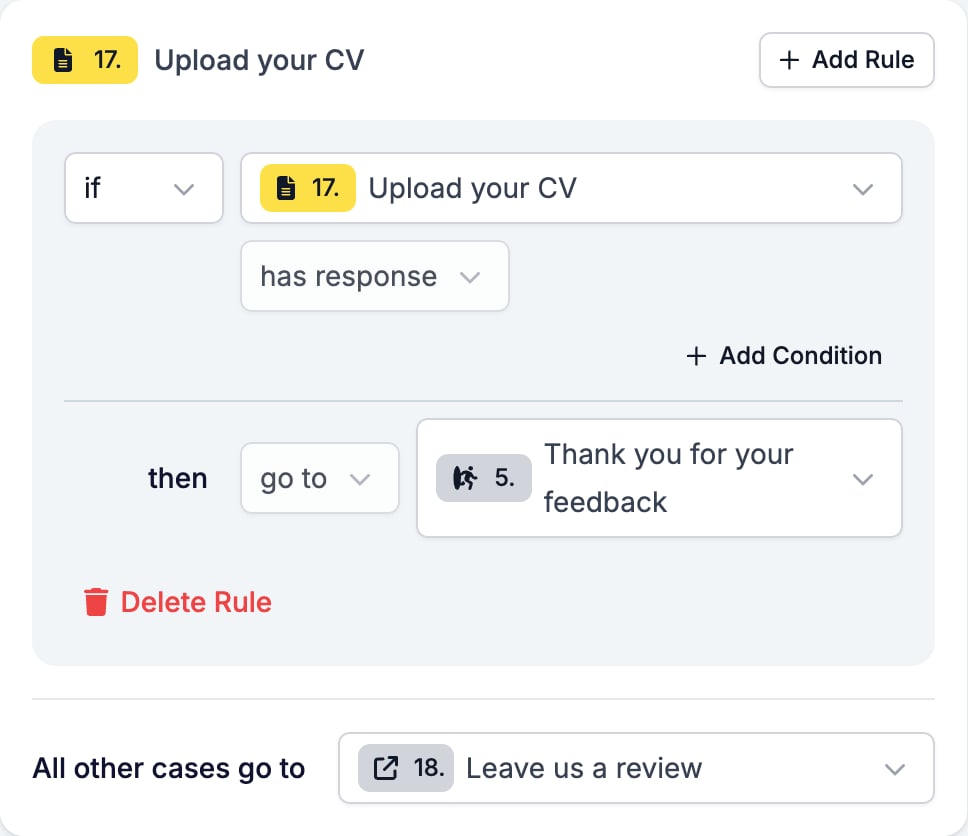
has response to route respondents who attached something differently from those who skipped it.
Testing and troubleshooting
The right side of the builder has three tabs: Interactive Preview walks the web form, Conversational Preview shows the chat version, and Test & Evaluate runs a response through the evaluators. Before you publish, walk the form once per branch in the Interactive Preview. It runs the same logic as the public form.- A rule never fires. Check that the condition’s question comes before, or is, the question that holds the rule. Rules cannot look ahead.
- The form jumps to the wrong question. Rules run top to bottom and the first match wins. Reorder the rules or narrow the earlier conditions.
- The respondent is stuck on a required question with no message. They answered No, turned a toggle off, or entered 0. See Required questions.
- A rule target is missing from the picker. The target is hidden, or it is the question itself. Unhide it or pick another target.
- The Yes/No value in a rule looks empty. It is a display quirk. Open the picker; the selected value is marked.
- A Yes/No auto reply is not sent. Yes/No uses Auto reply (Yes) and Auto reply (No), not the generic on-answer reply.
- The option you need is not in the rule’s value list. The list is the question’s options. Add the option on the Content tab first. When the options come from a data source, the list follows the source.