

Find appears in the picker only when a connected app offers a task in this category.
Settings
Each task has its own drawer. The shared settings are what to look for and where: the object or source to search, and the field values that identify the record. The tasks that fill the category in a workspace with Carerix and HireData connected:On the canvas
The card shows a Task badge, the task name with the connection under it, and a Filter block with the fields the task matches on.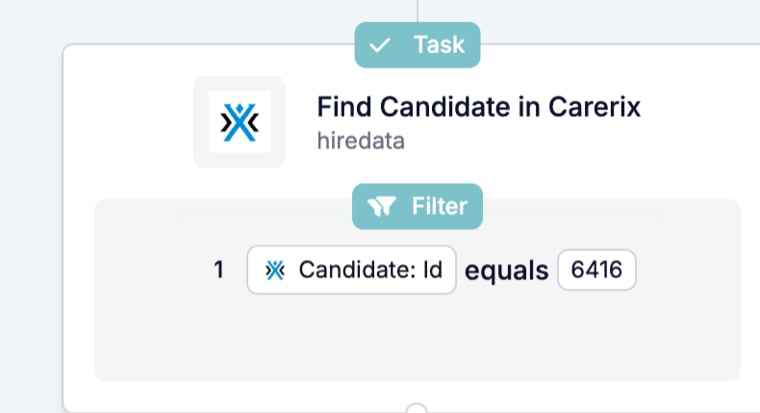
What it outputs
The record, address, or domain found. A Carerix Find opens on a Match found line with the record’s id and name, linking to the record in Carerix, and a Record Data block that lists every field the record carries. Later steps use those fields under the task’s name, so an Add task can attach the candidate a Find returned, and a Message task can address the email Find Email returned. Follow a run shows a Find step from a real run.What stops the run
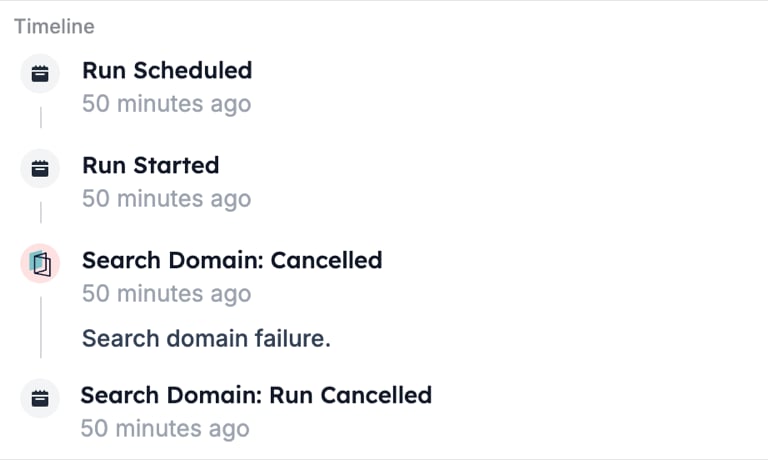
A Find that returns nothing. The task card turns red with the line “Cancelled” and the time, and the timeline records the task name with “Cancelled” and the reason, such as “Search domain failure.” for a Search Domain that found no domain. Steps after it show no status line. Open the card’s Fields tab to see the values the task searched with.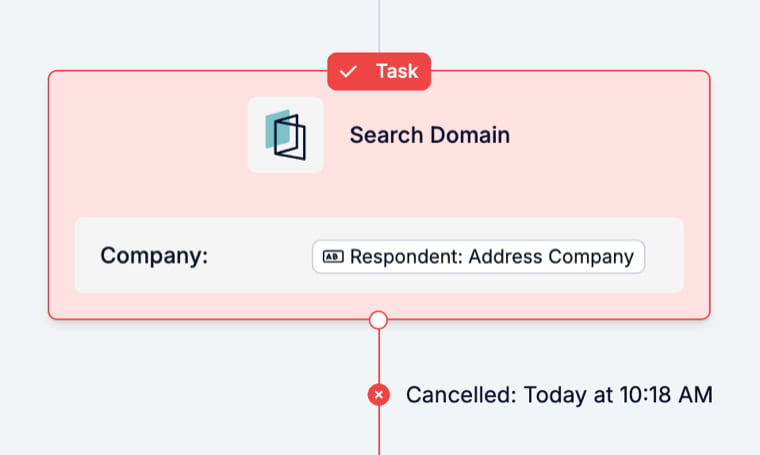
Patterns
- Find, then Update. When the event comes from a form and the record lives in your ATS, Find the record on an id or email from the response, then Update it with the answers.
- Find Email before Send Email. Search Domain gives the company’s domain, Find Email gives the person’s address at it, and the Message step sends to that address.
- Loop instead of Find for many. Find returns one record. To act on every record that matches, use a Loop.
Common mistakes
- Matching on a field that is not unique. A name matches more than one candidate. Match on an id or an email address.
- Finding what the event already carries. A Carerix event brings its record with it, and the Update task finds the record itself on the field you name. Add a Find only when the record is not in the event.
- Treating no result as a skip. An empty result cancels the run. If some events have nothing to find, put a Filter before the Find so those runs stop with a clear reason.
Related
- Add creates a record instead of finding one.
- Update changes the record a Find returned.
- Loop retrieves every matching record and runs steps for each.
- Task catalogue lists every task per connected app.