Email builder tour: blocks, toolbar, theme, and saving
A tour of the HireData email builder: the canvas and the settings panel, how you add a block, every block type, the toolbar, the theme, and saving.
An email template is a message you write once and send many times, in an automation or a newsletter. Open Settings, then Emails under Templates, and click New Email. Pick Blank Email or one of the ready-made templates, and the new template opens in the builder.This page maps the builder. For a walkthrough that takes one email from blank to ready, read Setting up an email template in HireData.
The Subject box across the top. It is the line the recipient sees in their inbox, and it takes variables.
The email itself on the left. Click any text in it and type. Click any block to select it.
The settings panel on the right, showing the settings of whatever you last selected.
Click a block’s text and you select that block, so the panel fills with the block’s own settings. To select the section that holds it, click beside the block instead, to the left or right of the text. Sections are not outlined in the canvas, so aim for the band of background colour a section fills.
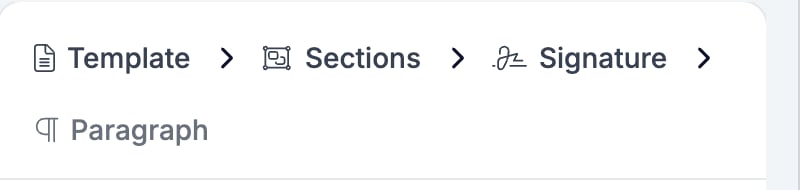
A template holds sections, and a section holds the blocks the recipient reads. Template explains how the three levels nest, how you move between them, and why you never add one and cannot delete it.A breadcrumb above the settings names everything that contains the selected block. Select a line of a signature and all four levels appear.
Every settings panel that can contain other blocks lists them under Blocks, numbered, in the order they appear in the email. Each row carries three controls.
The + adds a new block below that row. Where the container accepts more than one kind of block, it opens a menu of them.
The − deletes that block.
The handle on the left drags the block up and down the list.
Click a block’s own row to select it and open its settings. The breadcrumb walks back out. Click Sections for the settings of the section that holds the block, and Template for the settings of the email as a whole. The email on the left does not change. Only the panel does.
Two entries in the list cover more than one block. A Two Columns block arrives with its two columns already inside it, and a Socials block holds one child per network you link.
The toolbar runs along the top of the builder, from Save to the four drawer buttons on the right.Save stores your changes.Two buttons follow it:
The eye opens a preview of the finished email, at mobile, tablet, or desktop width, with a language picker and a Copy Preview URL button. Its tooltip warns that it saves the email first.
The paper plane opens Test Email. It sends the email to you with realistic values filled in.
Brand picks the brand the email’s colours, fonts, and logo come from.Two toggles follow the brand selector:
Show variable values is a display toggle for the canvas. To read an email with real values in it, use the preview.
Show code editor opens the generated markup. It appears only for accounts that may edit templates directly.
Four buttons at the end open drawers over the email:
Show variable list lists the variables this email can use, and adds ones of your own. See Variables.
Manage Template publishes the open email to the shared template library. It appears only for accounts that maintain that library.
Show objects links records such as a vacancy or a match to the email. Their fields then become variables you can write into it.
Manage Languages sets the email’s default language and its translations.
Every colour and font in a new email starts as a value from the brand you pick in Brand. The panel names the value rather than showing a hex code, such as “Theme: Palette Surface Color”.Switch Brand and the whole email restyles, blocks you already wrote included. Replace one of those values with a colour of your own and that one control stops following the brand. See Template for the settings that decide it, and for the difference between switching brand and setting a theme.
The email builder does not save as you type. Save saves. The preview button and Send test email each save before they run, so either of those commits whatever you have changed. See Testing.Try to leave the builder with unsaved changes and a warning appears. It offers to Save them, or to Discard them and carry on.Reload the page or close the tab instead and your browser asks you to confirm before you lose them.