

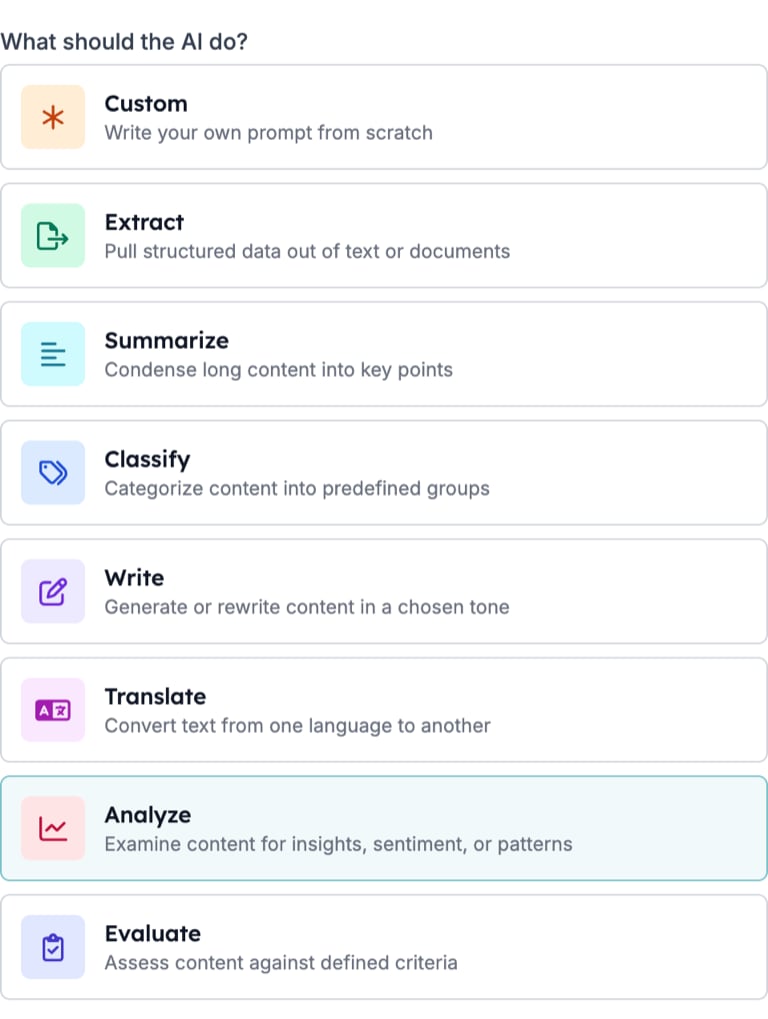
Settings
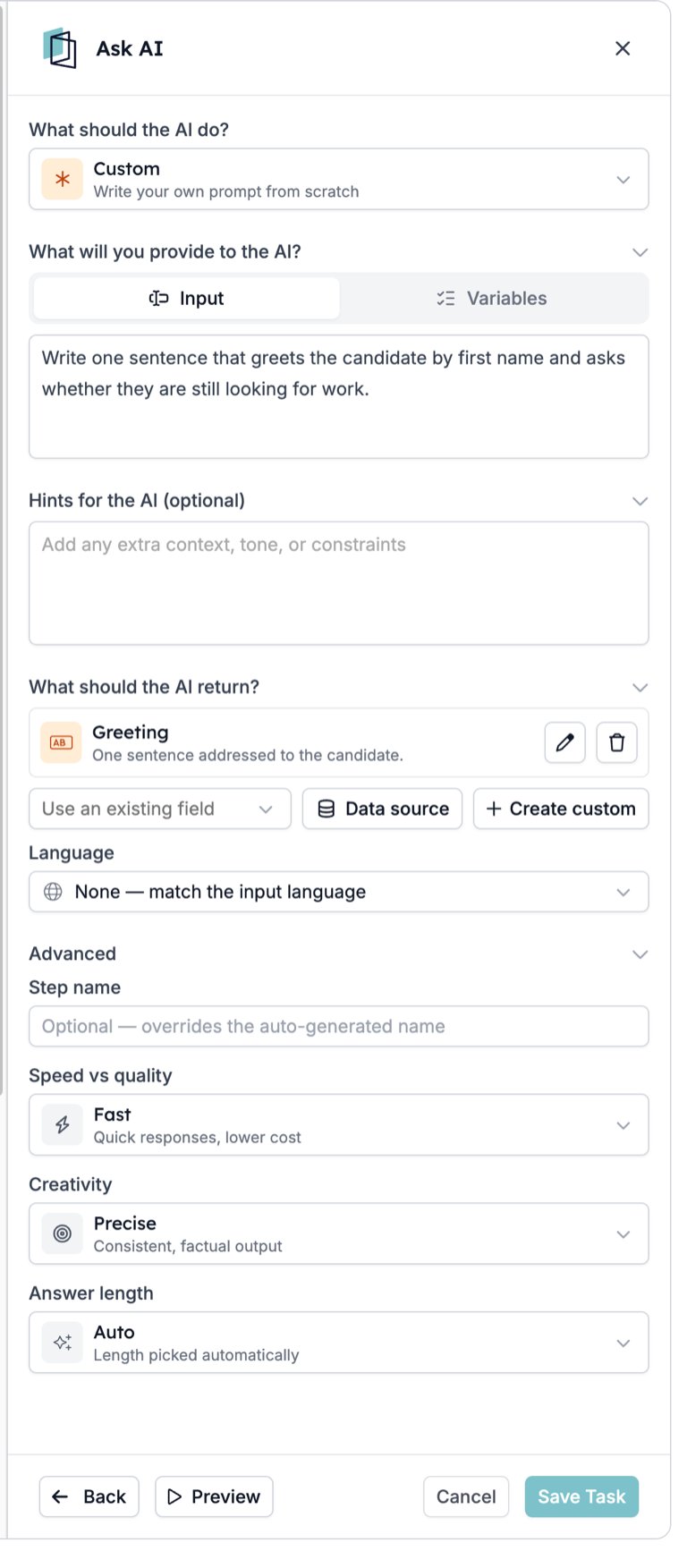
- What should the AI do? The intent, as a select once chosen.
- What will you provide to the AI? Two tabs. Input holds the prompt box; type your instruction and insert variables into it. Variables lists fields to pass alongside the prompt without writing them into the text.
- Hints for the AI (optional). Extra context, tone, or constraints, kept apart from the instruction.
- What should the AI return? The output fields. Use an existing field maps the answer onto a field the automation already knows. Data source returns a value from a data source. Create custom defines a new field. A saved field shows its name and description with buttons to edit or remove it.
- Language. The language of the answer, default None, which matches the language of the input.
- Advanced. Collapsed by default.
- Step name. Replaces the automatic name in the drawer header only. The canvas card and the variable names keep the automatic name. Every task drawer offers the same rename when you hover its name in the header.
- Speed vs quality. Fast (quick, lower cost), Balanced, or Quality (best results, slower).
- Creativity. Precise (consistent, factual), Balanced, or Creative (more varied).
- Answer length. Short, Medium, Long, or Auto.
New output field
Create custom opens a two-step dialog.- Choose Field Type. A Search types… box and the types in groups. Basics: Text, Number, Yes / No, List, ID. Date & Time: Date, Time, Datetime. People & Places: Email, Phone, Address, Country, Language, Locale, Timezone. Web & Media: URL, Domain, IP Address, Image, File, Color, Font. Advanced: Whole number, Decimal.
- Configure your field. Name is the label you see. Reference as is the variable name, default
textfor a Text field. What is it for? (optional) tells the model what to put in the field. Save & New saves and starts another; Done closes.
On the canvas
The card shows a Task badge, “Ask AI” followed by the intent, the prompt text, a chip per output field, and the three Advanced values. A variable in the prompt shows as a badge with the field’s name.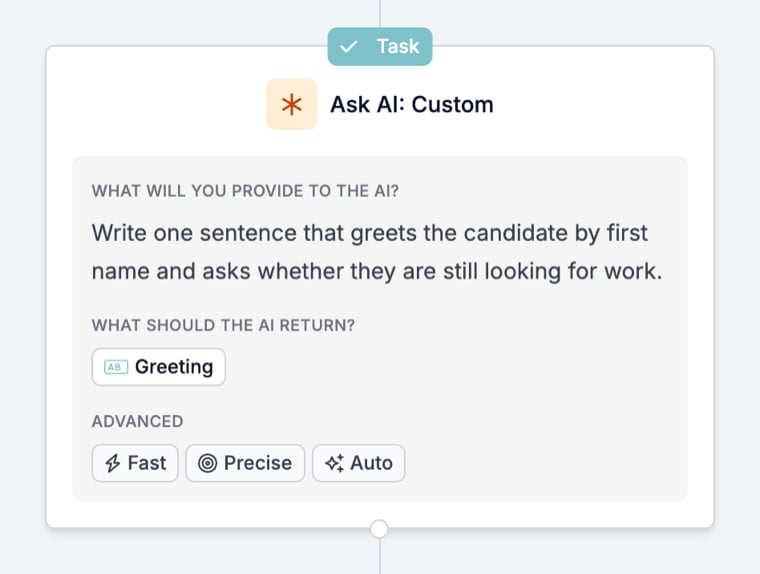
What it outputs
One variable per output field, named by its Reference as value, under the task’s name. Alongside them the task records whether the model answered, its reasoning, and an error message when it did not.
The run step’s Fields tab lists the values passed in and the values returned.
What stops the run
An answer the model could not give. The task card shows Cancelled with the reason in the timeline, and the steps after it show no status line. Prompts that run but return an unexpected value do not stop the run; check the output in a Filter when the next step depends on it. See Run cancellation reasons.Patterns
- Classify, then Split. A Classify prompt with a List output, then a Split whose branches filter on the list value.
- Extract into a record. An Extract prompt with one output field per value, then an Update task that writes the fields to the record.
- One sentence, not a whole email. For a personalised line inside an email template, an AI variable in the template does the job without a step. Use the Prompt step when the answer has to be stored or has to steer the run.
Common mistakes
- A prompt with no variables. Text alone gives the model nothing about this run. Insert the fields it needs into the Input box or add them on the Variables tab.
- Two fields with the same Reference as. The second overwrites the first. Give each output field its own reference.
- Expecting a rename to change the card. Step name, and the rename you reach by hovering a task’s name in its drawer header, change the drawer header only.
- Leaving Language on None for a fixed-language output. The answer follows the input’s language. Set the language when the record or template expects one.
Related
- AI variables generate a value inside an email, form, or automation without a Prompt step.
- Filter checks an output before the next step relies on it.
- Update writes output fields to a record.